
The Surprise Worshipers: When God Draws the Unlikely
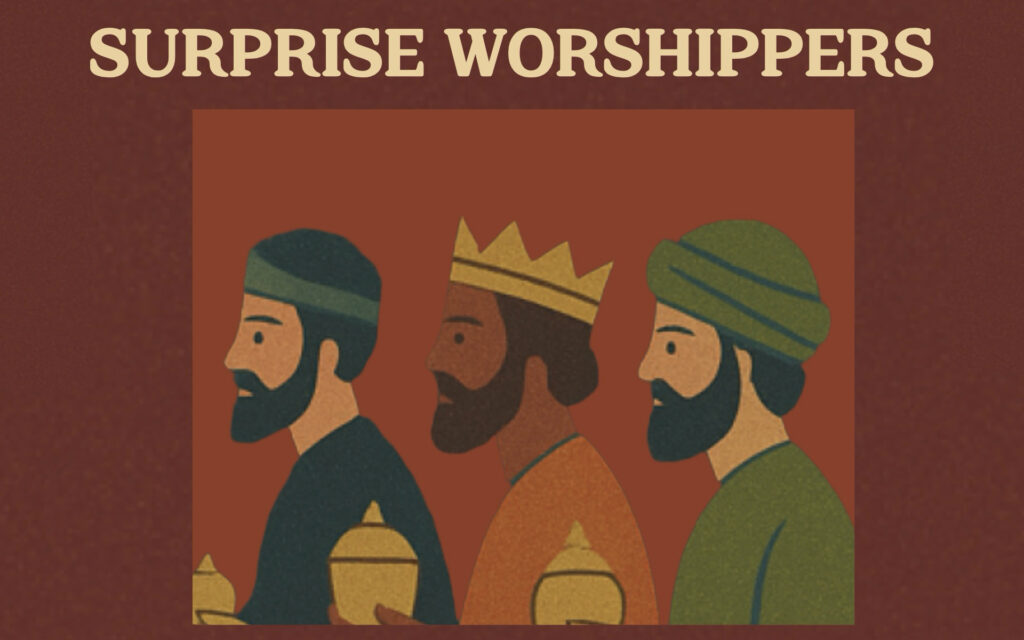
There’s something deeply fascinating about the Magi—those mysterious visitors from the East who followed a star to find the newborn King of the Jews. We’ve dressed them up in our traditions, given them names (Caspar, Balthazar, and Melchior), assumed there were three of them, and even crowned them as kings. Yet the biblical text tells us surprisingly little about these enigmatic figures.
What we do know, however, reveals something profound about the nature of God’s kingdom and His relentless pursuit of human hearts.
The Scholars Who Shouldn’t Have Cared
The Magi were not Jewish. They weren’t waiting for the Messiah. They weren’t part of God’s chosen people. In fact, they were pagans—scholars trained in a peculiar mix of astronomy, astrology, dream interpretation, and ancient texts. Think of them as a blend of astrophysicists and horoscope readers, priests and philosophers from distant lands.
By all reasonable expectations, these men had no business searching for the King of the Jews. Yet Matthew opens chapter 2 of his Gospel with their arrival, asking a question that would send shockwaves through Jerusalem: “Where is the one who has been born King of the Jews? We saw his star in the east and have come to worship him.”
How did they even know to look? How did pagan scholars from the East determine that a celestial sign pointed to a Jewish king—and not just any king, but one whose birth had cosmic significance for all nations?
Ancient Prophecies in Unexpected Hands
The answer likely lies in texts that had spread far beyond Israel’s borders. When the Israelites were exiled to Babylon centuries earlier, their scriptures traveled with them. The Hebrew Bible was translated into Greek. Jewish communities scattered across the ancient world. And suddenly, prophecies about Israel’s coming king were accessible to scholars everywhere.
Consider the prophecy of Balaam, a pagan prophet himself, who declared in Numbers 24: “I see him, but not now. I behold him, but not near. A star will come out of Jacob; a scepter will rise out of Israel.”
Or Jacob’s blessing over Judah in Genesis 49: “The scepter will not depart from Judah, nor the ruler’s staff from between his feet, until he comes to whom it belongs and the obedience of the nations is his.”
Notice that phrase: “the obedience of the nations.” Not just Israel. All nations.
Then there’s Daniel—himself trained in the Babylonian court as one of these scholarly Magi—who recorded visions of four great kingdoms followed by an eternal kingdom. In Daniel 7, he saw “one like a son of man” who would be given “authority, glory and sovereign power” so that “all peoples, nations and men of every language worshiped him.”
These texts were out there, circulating in the very regions where the Magi studied. When they looked up and saw something extraordinary in the heavens, these ancient prophecies suddenly clicked into place. Despite the long journey, despite the uncertainty, despite the cost—they came.
The Contrast That Changes Everything
Here’s what makes the Magi’s arrival so stunning: when they showed up in Jerusalem asking about the newborn king, the response was anything but welcoming.
King Herod was “disturbed, and all Jerusalem with him.” The religious scholars could quote exactly where the Messiah would be born—Bethlehem, just six miles away—but they didn’t bother to go see for themselves. While foreigners traveled hundreds or thousands of miles following fragmentary clues, the experts who had studied these prophecies their entire lives couldn’t be bothered to take a short walk.
The people who should have been first in line to worship were indifferent or hostile. The people who had no apparent reason to care were overjoyed.
When the Magi finally found Jesus—likely a toddler by this point, not a newborn—they didn’t see a palace or royal guards. They saw a young child in an ordinary house. Yet something stirred in their hearts by the Spirit of God. They fell on their faces and worshiped. They opened costly treasures—gold, frankincense, and myrrh—and laid them before this unlikely king.
And when warned in a dream not to return to Herod, they obeyed without hesitation, even though defying Herod was dangerous. Their worship was costly, complete, and courageous.
God’s Unscrupulous Pursuit
C.S. Lewis, recounting his own conversion from atheism, wrote: “A young man who wishes to remain a sound atheist cannot be too careful of his reading. There are traps everywhere… God is, if I may say it, very unscrupulous.”
God will use anything—a star in the sky, an ancient prophecy, a chance encounter, a friend’s invitation, even a childhood game song—to draw people to Himself. The Magi weren’t looking for God in the “right” way. They were studying things that would horrify pious Jews. Yet God met them where they were and used what they had to bring them to Jesus.
This is the stunning reality: if you’re reading this, if you’re hearing about Jesus in any way, God is actively pursuing you. You might feel far from Him. You might think you’re an unlikely candidate. You might be wounded by religion or skeptical of faith. But the Magi teach us that there is no one too far, no background too pagan, no path too twisted for God to use in drawing someone to worship His Son.
A Kingdom That Cannot Fail
The Magi were just the beginning. Matthew structures his entire Gospel to show that Jesus came not just for Israel but for all nations. He lived in “Galilee of the Gentiles.” He ended His earthly ministry with the command: “Go and make disciples of all nations.”
When Matthew wrote his Gospel, the church was a small, persecuted movement that seemed insignificant against the might of Rome. Yet he recorded Jesus’ words: “All authority in heaven and on earth has been given to me.”
Empires have risen and fallen. The Roman Empire is dust. Countless movements have tried to crush the church. Yet here we are, two thousand years later, with the gospel spreading faster than ever across every continent.
The stone Daniel saw in his vision—the one that struck the statue and grew to fill the whole earth—is still growing. The kingdom is still advancing. People from every tribe, language, and nation are still being drawn to worship the King.
Your Invitation to Worship
The story of the Magi is an invitation. It’s an invitation to recognize that God’s love is shockingly inclusive, that His pursuit is relentless, and that worship is the only reasonable response to encountering Jesus.
Perhaps you’re like the Magi—an unlikely worshiper, someone who never expected to be drawn to faith. Take heart. God specializes in surprising conversions.
Or perhaps you know someone who seems impossibly far from God. Don’t give up hope. If God could draw pagan scholars from the East to worship a Jewish toddler in Bethlehem, He can reach anyone.
The Magi teach us that there are no hopeless cases, no people beyond God’s reach, and no limits to His surprising love. The King they worshiped is still worthy of our worship today—and His kingdom is still advancing, one unlikely worshiper at a time.