
Guarding the Fire: How to Wait Well Without Burning Out
There is a passage in C.S. Lewis’s “The Screwtape Letters” that should stop every Christian cold. In it, the senior demon Screwtape coaches his apprentice nephew Wormwood on the most effective strategy for pulling a person away from faith. His advice is not to tempt someone into a dramatic, catastrophic sin. That approach, Screwtape warns, risks shocking the person back to their senses. The far more reliable method is gradual. As Lewis writes through the voice of Screwtape: “The safest road to hell is the gradual one, with gentle slope, soft underfoot, without sudden turnings, without milestone, and without signposts.”
It is a chilling image. And it is exactly the kind of slow drift that the Apostle Paul was warning against when he closed his first letter to the Thessalonians.
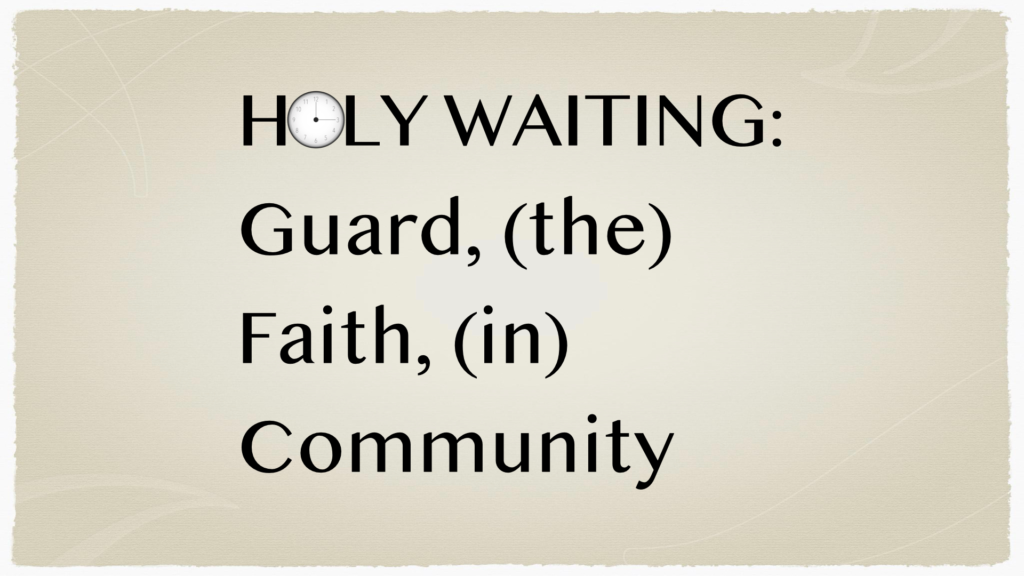
In 1 Thessalonians 5:19-28, Paul delivers a rapid-fire series of commands to a young church learning how to live faithfully while waiting for the return of Christ. The instructions are not complicated. They do not require a theology degree to understand. But they do require honesty, discipline, and community. Three themes rise to the surface that are as urgent today as they were in the first century.
Guard the Fire
Paul opens with a command that is striking in its imagery: do not quench the Spirit. The Holy Spirit is consistently described throughout Scripture as fire, and Paul’s instruction assumes that the fire can be suppressed. It will not go out entirely in the life of a believer, but it can smolder. It can lose its heat. It can stop blazing.
Think about a campfire. When you feed it with good, dry wood, it burns bright and warm. But when you start throwing garbage into it, the fire does not necessarily die, it just becomes something lesser. It smolders. It chokes. The same thing happens to our spiritual lives when we stop being intentional about what we allow in.
Proverbs 4:23 makes the connection plain: everything that flows out of a person’s life flows from the heart. Guard it. The entry points matter. What you watch, what you consume, what you dwell on, what you let accumulate without confession, all of it either feeds the fire or smothers it.
Unconfessed sin is one of the most common ways the fire gets quenched. Not because sin disqualifies a person from grace, but because sin left unaddressed festers. It builds. It desensitizes. The enemy does not hand you a chain. He hands you a single link. Then another. Then another. And before long, you have assembled your own bondage, one small compromise at a time.
Paul also warns against despising prophecy, which in the broader sense means dismissing the work of God when it happens around you. Cynicism is a fire-quencher too. When we become so familiar with church, with Scripture, with spiritual community that it all becomes background noise, we have stopped guarding the flame.
But here is the balance Paul insists on: test everything. The standard for testing is the Word of God. Not every voice claiming spiritual authority deserves uncritical acceptance. The fire must be guarded on both sides, against cynicism that dismisses everything, and against naivety that accepts everything.
Trust the Finisher
Here is where the passage becomes genuinely breathtaking. After calling believers to guard their hearts and stay spiritually alert, Paul pivots and makes a confession that should bring enormous relief: God already knows you cannot do this perfectly.
In 1 Thessalonians 5:23-24, Paul prays that the God of peace himself would sanctify believers completely, keeping their whole spirit, soul, and body blameless until the coming of Christ. Then he adds the line that deserves to be written on every bathroom mirror and memorized by every discouraged Christian: the one who calls you is faithful, and he will do it.
He will do it. Not you. Him.
This is not a license for passivity. Guarding the fire still matters. Obedience still matters. But the pressure of producing your own holiness is not yours to carry. God is the architect. He breathed life into you at salvation and he is not walking away from that project. The blamelessness Paul describes is not moral perfection achieved through sheer willpower. It is the covering of Christ applied to a person who has confessed, surrendered, and trusted.
We live in a culture obsessed with self-sufficiency. Fix it yourself. Optimize yourself. Build yourself. And that instinct bleeds into our faith until we are treating our relationship with God like a home improvement project, consulting the right videos, following the right steps, expecting results. But the gospel does not work that way. The finished work of Christ on the cross is the only foundation that holds. The switch from “how do I fix this” to “Lord, I trust you with this” is one of the most important transitions a Christian can make.
Lean Into Community
Paul closes his letter with something surprisingly personal. He asks for prayer. The man who wrote much of the New Testament, who planted churches across the Roman world, who endured imprisonment and beatings for the gospel, says simply: brothers, pray for us. He is not above the community. He is in it.
He then instructs the church to greet one another with a holy kiss, which in their cultural context was a sign of genuine family bond. It was countercultural in a society stratified by class and status. When a master greeted a slave as a brother, the watching world took notice. The church was meant to be visibly different in how it loved.
And he charges them to share the letter with everyone. The Word of God is not meant to be hoarded. It circulates. It multiplies. It does its work through community, through conversation, through one person sharing what God has done in their life with another person sitting across a table.
Isolation is one of the enemy’s favorite tools. A fire left unattended dies. A fire tended by a community burns through the night.
The call of 1 Thessalonians 5 is not complicated, but it is demanding. Stay alert. Trust God to carry what you cannot carry. And do not try to do any of it alone. The season of waiting is long, but the one who called you is faithful. He will surely do it.