
Catechism Question 81
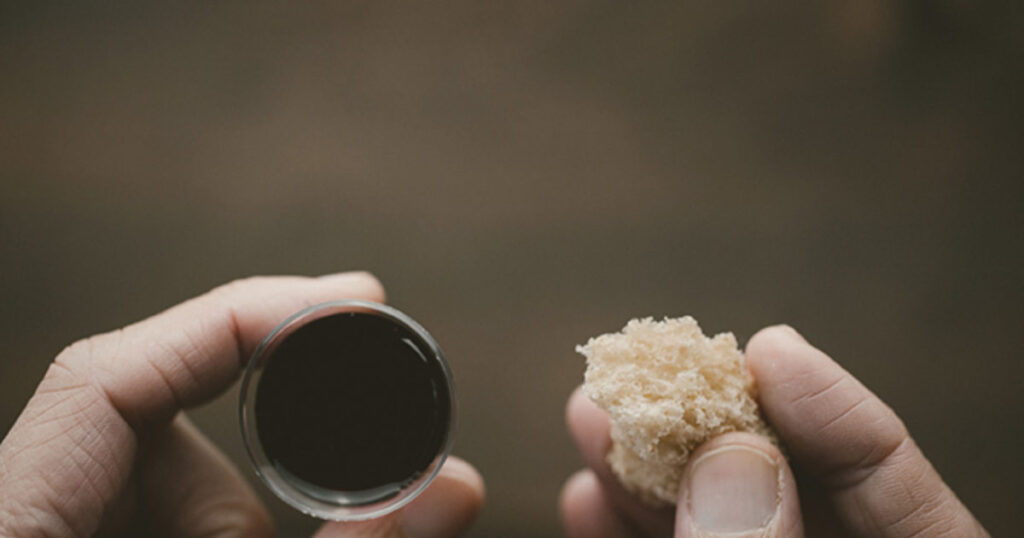
Do the bread and wine actually become the very blood and body of Christ?
No. The bread and wine are symbols of His body and blood, His redeeming life and death for us, and they unite us to Christ and all of His saving benefits when received properly.
Focus and Purpose of this Question
This is the fourth in a series of questions on the Lord’s Supper. In this question, we discuss whether the bread and wine are physically transformed so that they become the literal, physical body and blood of Jesus. The Roman Catholic church teaches the doctrine of transubstantiation – that the elements of bread and wine are transformed into the physical body and blood of Christ as the priest consecrates the elements. They admit that they still look, smell, feel, and taste like bread and wine. But following categories provided by Aristotle, they say that although the outward characteristics (the accidents) do not change, the inner essences (the substances) are transformed into the body and blood of Christ. However, while this is an application of Aristotelian philosophy, it finds no support in Scripture.
It is important to understand that Jesus does speak of the bread and the wine as His body and blood, but He clearly does so using figurative language. This is apparent for a few reasons. First, as He says these words, His real, physical Body is still sitting right there in front of the disciples. Second, because Jesus has a real, human, physical body, it shares the same characteristics as our bodies, and therefore could not have been in multiple places at once (as would have had to happen as He uttered the words and also at every celebration of the Lord’s Supper since that time.) Third, sacraments, by their very nature, are symbols that point to something else, and they do not become the thing they signify (see question 72). For example, the water in baptism points to the death, burial, and resurrection of Christ, and also to our cleansing from sin, and yet the water is not changed into the blood of Christ, or into His tomb. Nor were we literally, physically buried with Christ. It remains water – but it unites us to Christ’s bloody death, His burial, and His resurrection, and conveys those benefits to those who are baptized in faith. So also here, the sacramental symbols of bread and wine point to the body and blood of Christ and His death for us, but they do not actually become the body and blood of Christ.
However, while denying that the elements are somehow changed into the actual body and blood of Christ (the doctrine of the Real Presence), it is imperative that we do not overreact and deny the real presence and work of Christ at His Table through the work of the Spirit. If we partake of the elements in faith, they spiritually unite us to Christ and strengthen us in the faith as we feed our souls upon Him and all of His saving work in our behalf. In rejecting the doctrine of the Real Presence, let us not overreact and embrace a doctrine of the Real Absence – as if Christ were present everywhere except at His Table! There is a real union with Christ and a real feeding – but are spiritual, not physical.
Additional Questions:
Are the bread and wine physically transformed into the literal body and blood of Jesus?
Scripture References:
Matthew 26:26–29
While they were eating, Jesus took bread, gave thanks and broke it, and gave it to his disciples, saying, “Take and eat; this is my body.” 27 Then he took the cup, gave thanks and offered it to them, saying, “Drink from it, all of you. 28 This is my blood of the covenant, which is poured out for many for the forgiveness of sins. 29 I tell you, I will not drink of this fruit of the vine from now on until that day when I drink it anew with you in my Father’s kingdom.”
John 6:35, 47–51, 63
Then Jesus declared, “I am the bread of life. He who comes to me will never go hungry, and he who believes in me will never be thirsty… 47 I tell you the truth, he who believes has everlasting life. 48 I am the bread of life. 49 Your forefathers ate the manna in the desert, yet they died. 50 But here is the bread that comes down from heaven, which a man may eat and not die. 51 I am the living bread that came down from heaven. If anyone eats of this bread, he will live forever. This bread is my flesh, which I will give for the life of the world.”… 63 The Spirit gives life; the flesh counts for nothing. The words I have spoken to you are spirit and they are life.
1 Corinthians 10:1–4
For I do not want you to be ignorant of the fact, brothers, that our forefathers were all under the cloud and that they all passed through the sea. 2 They were all baptized into Moses in the cloud and in the sea. 3 They all ate the same spiritual food 4 and drank the same spiritual drink; for they drank from the spiritual rock that accompanied them, and that rock was Christ.
1 Corinthians 10:16–17
Is not the cup of thanksgiving for which we give thanks a participation in the blood of Christ? And is not the bread that we break a participation in the body of Christ? 17 Because there is one loaf, we, who are many, are one body, for we all partake of the one loaf.
Romans 6:3–4
Or don’t you know that all of us who were baptized into Christ Jesus were baptized into his death? 4 We were therefore buried with him through baptism into death in order that, just as Christ was raised from the dead through the glory of the Father, we too may live a new life.
Questions for Further Discussion:
Why is it important to understand that the bread and wine do not literally become the physical body and blood of Jesus?
What would it say about the nature of Jesus’ humanity and His body if His body literally became present in multiple places at once, both while He was on the earth and even now that He has ascended to the right hand of the Father? If Christ is not physically present with all believers, how is He present with us? How is He present with us in the Lord’s Supper?
What does Jesus mean when He says He is the true Bread of Life? Was He literally bread?
What does Jesus mean when He says we must eat His flesh and drink His blood to have life? Was He speaking of physical or spiritual life? Was he speaking of physical or spiritual eating?
How do we feed upon Christ at His Table? Do we literally eat His flesh and drink His blood – or do we feed upon Him spiritually?
Is Christ actually Present with us at His Table? Do we actually receive anything by coming to His Table?
Additional Information:
This question is based on questions 78 and 79 of the Heidelberg Catechism, and question 96 of the Westminster Shorter Catechism. Any resources you find on the Heidelberg or Westminster Shorter Catechisms will have a good discussion on this question.
For additional information, see the teachings “Jesus is the Bread of Life” (February 14, 2016), “Communion” (June 3, 2012), and “What Is A Sacrament” (March 7, 2010).
Suggested Worship Song:
Communion Song (Barry McGuire)
(This simple song reminds us that as we take the bread and the cup, we remember the broken body and shed blood of Christ, which were given for us on that day at Calvary so long ago.)
Verse 1
Take this bread I give to you
And as you do remember Me
This bread is My body broken just for you
Take it (take it)
Eat it (eat it)
Each time you do
Remember Me remember Me
Verse 2
Take this cup I fill for you
And as you do remember Me
This cup is the new covenant
I’m making with you
Take it (take it)
Drink it (drink it)
Each time you do
Remember Me remember Me
Verse 3
Take this love I’ve given you
And as you do remember Me
Remember Me remember Me
Each time you do
Remember Me remember Me