
Catechism Question 63
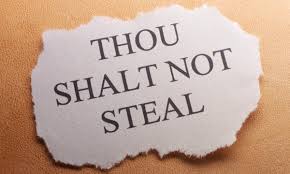
What is the eighth commandment, and what does it teach us?
The eighth commandment is “You shall not steal.” It teaches us that we must not steal through theft, deceit, trickery, or fraud, but must be content and work hard to take care of our own needs and to have enough to share material possessions with those in need.
Focus and Purpose of this Question
This question focuses on the eighth commandment. In this commandment, we are told that we must not steal. God calls His people to be honest and to not take that which belongs to another. To take that which belongs to another is a violation of God’s character, for He is a God who gives generously.
However, as with all of the other commands, more than the thing specifically mentioned (stealing) is in view. Theft may occur in many forms. It is certainly stealing to physically take that which belongs to someone else for which we have not paid, but it is equally theft to knowingly and purposefully deceive someone into a situation where we acquire that which belongs to them without adequate compensation. It is also theft to commit fraud – convincing someone that if they purchase something from us it has a certain value or ability that we know is not true. All such actions are forbidden by this commandment.
Furthermore, the New Testament once again teaches us that this command not only forbids theft in our actions but also forbids greed in our thoughts and desires.
To lust after someone to whom we are not married is sin, even if we do not act upon the thoughts or desires. God calls us to be pure in heart, mind, and body. In fact, it calls greed “idolatry” and thus makes it a violation not only of this command but also of the first command. Once again, this is because if we are greedy in our thoughts, it will lead to greedy actions – which usually usher in theft in one form or another.
Finally, the New Testament teaches us that we are also commanded to do the opposite of what is forbidden. We must not only avoid stealing – we must work hard to earn what we need and even more so that we are able to share and help those in need. Far from being thieves, as God’s children we are called to be like our Father – generous, freely giving to others. This is the import of the eighth commandment.
Additional Questions:
What is the eighth commandment? What does it teach us?
What is the eighth commandment? What does it forbid us from doing? What does it teach us to do?
Scripture References:
Exodus 20:15
You shall not steal.
Deuteronomy 5:19
You shall not steal.
Leviticus 19:35
Do not use dishonest standards when measuring length, weight or quantity.
Proverbs 11:1
The Lord abhors dishonest scales, but accurate weights are his delight.
1 Corinthians 6:9–11
Do you not know that the wicked will not inherit the kingdom of God? Do not be deceived: Neither the sexually immoral nor idolaters nor adulterers nor male prostitutes nor homosexual offenders 10 nor thieves nor the greedy nor drunkards nor slanderers nor swindlers will inherit the kingdom of God. 11 And that is what some of you were. But you were washed, you were sanctified, you were justified in the name of the Lord Jesus Christ and by the Spirit of our God.
Colossians 3:5
Put to death, therefore, whatever belongs to your earthly nature: sexual immorality, impurity, lust, evil desires and greed, which is idolatry.
Ephesians 5:3
But among you there must not be even a hint of sexual immorality, or of any kind of impurity, or of greed, because these are improper for God’s holy people.
Exodus 23:4–5
If you come across your enemy’s ox or donkey wandering off, be sure to take it back to him. 5 If you see the donkey of someone who hates you fallen down under its load, do not leave it there; be sure you help him with it.
Ephesians 4:28
He who has been stealing must steal no longer, but must work, doing something useful with his own hands, that he may have something to share with those in need.
Hebrews 13:16
And do not forget to do good and to share with others, for with such sacrifices God is pleased.
1 Timothy 6:17–18
Command those who are rich in this present world not to be arrogant nor to put their hope in wealth, which is so uncertain, but to put their hope in God, who richly provides us with everything for our enjoyment. 18 Command them to do good, to be rich in good deeds, and to be generous and willing to share.
Acts 20:35
In everything I did, I showed you that by this kind of hard work we must help the weak, remembering the words the Lord Jesus himself said: ‘It is more blessed to give than to receive.’
Questions for Further Discussion:
What does the eighth commandment teach us? What does it forbid? What does it command us to do?
Why is theft wrong? Is it simply because it deprives someone of their own property, or are there other reasons that make theft evil?
Is theft only the physical taking of someone else’s property, or are there other ways to steal? Where is this seen in Scripture?
What are some forms of theft that occur today that do not involve physically stealing something? What about digital products? What about false advertising? Are these forms of theft? Why or why not?
What does this command teach about the importance of private property?
What does this command teach about sharing with those in need? If I scrupulously avoid theft, but do not share with the needy, have I kept this command or violated it?
Additional Information:
This question is based on questions 110-111 of the Heidelberg Catechism, questions 73-75 of the Westminster Shorter Catechism, and question 11 of the New City Catechism. Any resources you find on the Heidelberg, Westminster Shorter, or New City Catechisms will have a good discussion on this question.
For additional information, see the teachings “Greed” (March 11, 2018), “Shaping A Contented Soul” (November 26, 2017), and “All In: The Disciple and Money” (October 18, 2015).
Suggested Worship Song:
Be Thou My Vision (Public Domain)
(This song teaches us that we are to find everything we need in Christ. In particular the next to last verse teaches us to not look to earthly riches but rather the Christ as our real treasure.)
Be Thou my Vision, O Lord of my heart;
Naught be all else to me, save that Thou art.
Thou my best Thought, by day or by night,
Waking or sleeping, Thy presence my light.
Be Thou my Wisdom, and Thou my true Word;
I ever with Thee and Thou with me, Lord;
Thou my great Father, I Thy true son;
Thou in me dwelling, and I with Thee one.
Riches I heed not, nor man’s empty praise,
Thou mine Inheritance, now and always:
Thou and Thou only, first in my heart,
High King of Heaven, my Treasure Thou art.
High King of Heaven, my victory won,
May I reach Heaven’s joys, O bright Heaven’s Sun!
Heart of my own heart, whatever befall,
Still be my Vision, O Ruler of all.